Followers

Saturday, January 20, 2018

Leaky Waders

Sometime in the late 14th century, Geoffrey Chaucer coined the phrase, "But at the laste, as every thing hath ende."  You probably recognize it better as "all good things must come to an end."  And, for the most part, it's true.  The Atlanta Braves had an unprecedented run of division titles, but it ended at a major league record 14 years.  And they don't look likely to win any more any time soon.  Star Wars has been one of the most successful movie franchises of all time, but you know there had to be a Last Jedi eventually.  Ford produced the best selling compact pickup of all time, the Ranger, for 28 years before finally putting the little work horse out to pasture.  And today, I said goodbye to my favorite pair of waders.  

I bought them back in 2003 in Bob Ward's in Bozeman, Montana.  I was with some buddies on a fishing trip and Bob Ward's was having a clearance on some of their fishing gear.  They were Hodgman Wadelite breathable stockingfoot hip waders and from that trip forward, they were my favorite waders.  I have a pair of Orvis chest waders that cost three times as much, but those Hodgmans were my standard.  I preferred them over everything else.  They were quick to put on and take off.  They allowed total range of motion and freedom when bushwhacking and boulder crawling.  They were the perfect gear for when the weather is too hot for chest waders but water is too cold for wet wading.


My favorite waders and me on the second meadow of Slough Creek


Like a good dog, they went with me everywhere.  Montana, Wyoming, Colorado, Tennessee, North Carolina, and Georgia, I wore them on little speck creeks all the way up to the Yellowstone river.  I've fished some legendary waters in these waders.  And like when an old dog dies, I'm pretty bummed to have to put them down.  They don't make them anymore.  

I knew this day was coming.  I've worn them every summer for 15 years.  I've patched holes, trying to delay the inevitable, but I feel like the little Dutch boy trying to stem the flood.  Too many recent trips, I've come home with squishy socks.  I suppose I'll try to find a replacement.  Chota makes a model that looks like it might fit the bill.  I doubt I'll throw these old ones away.  I'll probably keep them around, just for old times' sake.


Friday, January 19, 2018

A Storm Bruin

I love chestnuts.  I mean, they're pretty good to eat, with a sweet and nutty flavor.  Apparently you can roast them on an open fire, but I've never tried.  But I really love to hunt over them in the early parts of archery season here in north Georgia.  Deer have been browsing all spring and summer on native flora like blackberry, honeysuckle, clover, wild grape, dogwood and if near a settlement, garden staples like okra, beans, peas and your wife's favorite hostas.  As summer wanes and fruit trees start to drop, apples and pears are in high demand.

And then there's the lull between the time that apples have been mostly consumed and the time the most prominent mast crop, acorns, begin to fall.  Deer that have been easily patterned on reliable food sources all summer, seemingly up and disappear.  Unless you have something drawing them in.

Enter the chestnut.  In my neck of the woods, chestnuts (And we're talking the blight-resistant Chinese chestnut) usually begin to drop their heavily armed burs around the end of August or first of September.  Being the only high protein, high carb mast available, deer will flock to them.


Notice the cracked, and emptied hulls where deer or bear have chewed them to get at the sweet meat inside.


I'm fortunate enough to own some property with a pair of old chestnut trees that still produce.  These particular trees were planted on an old farmstead many years ago and though the farm and all remnants of it are gone, the twin chestnut trees remain and drop their bounty every year.  


The smaller of the two is pictured in the background of this trail cam picture with the yearling directly under it.  I had several series of pictures with as many as five does feeding on the chestnuts in late August and early September.


I was fortunate enough to harvest a doe underneath the chestnut trees on the opening morning of archery season.  She rolled out the red carpet for me!


Two days later, the governor declared a state of emergency for all 159 counties in the state of Georgia.  Hurricane Irma was working her way up the coast of Florida and was expected to bring widespread destruction far into Georgia.  Watching the radar, I knew I would have several hours before anything destructive made it to the mountains and I figured game would be moving ahead of the approaching storm, so I headed once again to my ground blind overlooking the chestnuts.  

Daylight had just broken softly under cloudy skies and light rain.  It was still very dark inside the blind and I had just checked the radar again on my phone when I caught movement out of the corner of my eye.  I was momentarily shocked when I looked up and saw a bear loping into my field of view.  He made no sound and when I first saw him, he was only ten yards away.  I had no pictures of him on camera, but he clearly knew the chestnuts were there because he went straight to them and began feeding.  I drew my bow, settled my pin behind his front shoulder and released an arrow.  I watched the arrow disappear and the bear grunted, then wheeled and ran.  After giving him half an hour, I found him about 100 yards from the blind.


Bear meat has a reputation for being tough and gamey.  I believe this reputation is undeserving and points more towards mishandling of the meat after the kill than the actual properties of bear meat itself.  

Bear meat has a distinct flavor that is more similar to beef than venison.  


And when paired with cream cheese, jalapenos, bacon and raspberry jam, it will blow your mind!


The Christmas Buck

The 2017 deer season was a productive one for me.  In north Georgia, our archery season begins the second weekend of September and runs till mid-January.  Rifle season begins the third weekend of October, after a week long muzzleloader season, and runs until the season ends in mid-January.

I typically spend archery season trying to get a head start on filling our freezer.   With a family of five and an appetite for red meat, I try to put up at least five deer each year.  Most years, by the time Thanksgiving is over, I'm done deer hunting and can spend some time on other pursuits like small game and waterfowl.  2017 was no different.  By December, I had harvested four deer and a black bear and our winter meat supply was looking good.

So it was, that I found myself taking my young son on a squirrel hunt on a cold, late December morning.  At the inquisitive age of three, he isn't exactly stealthy in the woods, and we didn't manage to shoot any squirrels.  However, as we walked along climbing logs and jumping off and asking a million questions, I did begin to notice some very good buck sign that hadn't been there three weeks earlier.


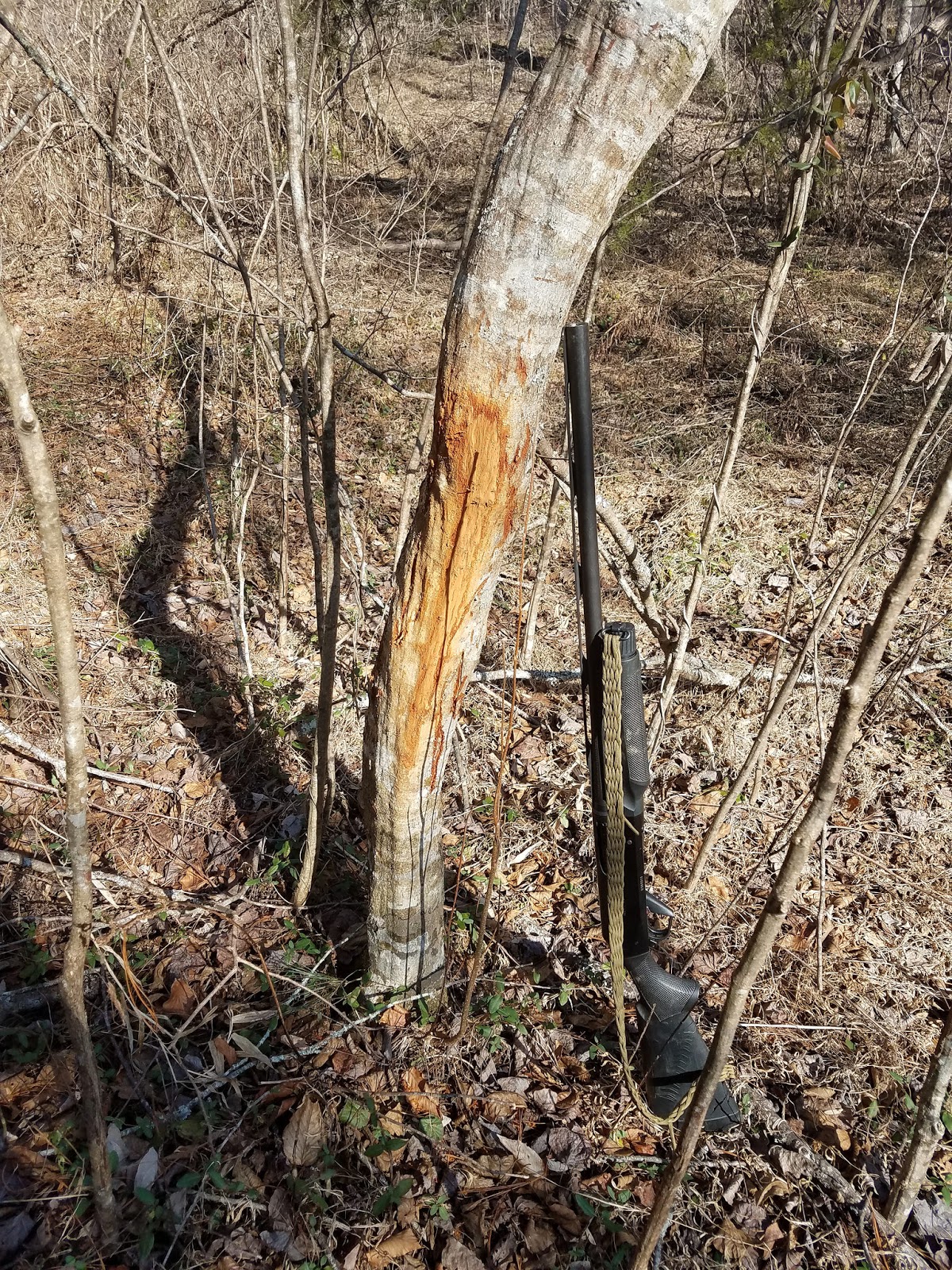
First one, then another. Then I began to notice that every sapling traveling in a certain direction had been rubbed.  I could stand in one place and scan the trees ahead and sometimes see as many as a dozen rubs.  And they were fresh.


And some of them were quite large.  Not only that, many of them were done on what we call Ironwood trees (American Hornbeam) that are very hard and very tough.  I've made walking sticks out of ironwood and scraping off the bark is a job for a power tool.  But whatever buck had made these rubs had no trouble shredding them.


For reference, that's a Benelli Super Black Eagle II leaning against that tree.  When I saw this, I knew I had to come hunt this deer. 


We spent the morning of Saturday, December 23rd eating breakfast with my wife's family.  It drizzled a light rain most of the morning and turned into a heavy drizzle as we drove home around lunch.  After we got home, I checked the weather and saw that the rain would be ending around 2:30pm and colder weather would be following.  I knew that deer would likely be on their feet as soon as the rain stopped, so I put on my Gore-Tex, grabbed my rifle, and headed for the woods.  

I love hunting after a rain.  The wet leaves and softened ground mutes every footstep and I was able to stealthily slip along a thick creek bottom where the buck had obviously been traveling.  I had seen a fresh scrape in an old logging roadbed, but it was in an area that was too open for a late season buck to likely visit in daytime hours.  I suspected that he would be bedding in either a laurel thicket on the east side of the creek or a mature pine thicket on the west side.  I positioned myself fairly between the two thickets, hoping I could catch a glimpse of him moving down the creek.  

The place I had chosen was thick with fallen white pines and choked with underbrush that had sprung up to reach the exposed sky where once dark canopy had been.  I could see three different rubbed pine saplings from my position.  Even so, I felt uneasy about my choice of location.  I couldn't see very well in any direction and kept second-guessing myself, wondering if I should backtrack and go watch that scrape.  With the leaves wet and ground saturated, I knew I wouldn't hear a deer approaching, but would have to keep my head on a swivel and see him before he saw me.  But knowing a late season buck would likely stick to the the thickest cover he could find, I stayed put.  I could just envision a mature old buck slipping along silently out of the stand of pines on his way into the safety of a tangle of laurels.  

And with less than half an hour of shooting light left, I saw the gleam of white antlers slipping along through the pines.  He was moving at a brisk pace, and as he reached the edge of the pines, he stopped briefly to survey his surroundings.  That's the only pause I needed before I dropped him where he stood.  


Capping off a successful season, this healthy southern Appalachian whitetail would add more free range, low-fat, organic protein to my family table, and provide a handsome trophy in my future man-cave.


After aging his lower jaw, I determined that he was 4 1/2 years old, a mature adult buck.


Thursday, January 18, 2018

A Remedy For Cabin Fever

These arctic blasts we've been seeing rather frequently this winter have not been friendly for my little ones.  My children love to play outside, but when the daytime highs don't reach the freezing mark, (yesterday's high was 19) there's not much they can do outside for very long.  Mom and I can only abide so much television and she's done her best to keep them engaged in painting and crafts.  But today, I said we were getting out, regardless of weather.  So I packed us lunch while Mom got them dressed and we headed out for an adventure.


When we parked at the trailhead, the kids recognized where we were and began asking if they could slide down the waterfall like last summer.  Not today, kids.


A giant hemlock stump, another victim of the the wooly adelgid.


Temps hadn't risen to above 20 in about three days.  Everything has a protective coating of ice.


The climb from the lower falls to the upper falls was very treacherous.  Most of the footpath was solid ice, but the end was worth the hike.


After we got our fill of the waterfall, the kids were getting hungry.  Mom gave them snacks while we headed for destination number two.  We hiked to an old campsite that I grew up camping in and let the kids explore the creek and the woods while I fixed lunch.


Mountain House prepared on the Blaze stove.


There's something about a creek that appeals to every kid.


And you can't go to a campsite and not have a campfire.


Wednesday, January 17, 2018

A Little Help From Pap

I killed my first deer when I was 12.  My parents had given me a Marlin 336 chambered in 30-30 the previous Christmas and my dad took me to the deer woods one cold Saturday morning after he had fed the cattle.  I took a young spike buck that tipped the scales at a shade over 70 pounds dressed.  Dad took me for my first few deer hunts, but the man that I hunted with more than any other in my youth was my grandfather, Pap.

Pap was the quintessential southern Appalachian woodsman.  He had spent virtually his entire life in the woods.  Born five years before the Great Depression got great, he was raised in one of the most beautiful valleys in the state.  He coon hunted, he trapped, he fished, and he blazed trails through the mountains around where he lived.  And on top of all that, he was a logger.  So it's safe to say that few people spent as much time in the woods as Pap.  He spent his days and his nights in the woods and he knew them like no one else.

It was his knowledge of the woods that impressed me most as a young man.  Pap could identify every tree in the woods.  Not only did he know the species, he knew several individual trees by sight.  Pap had a remarkable memory for detail.  Many were the times we would be walking through the woods and Pap would point his dogwood walking stick at a tree and tell a story about a hunt many seasons ago when hounds long dead had treed a coon.  He could remember who he was hunting with, which dog had struck the track first and how many coons were in the tree.  I heard so many tales of Pap's hounds from over the years, I felt as if I had known them all.  There was Buttermilk and Bawly, Champ, and Old Blue.

Pap was legendary for his pace in the woods.  Even at an advanced age, in his seventies, Pap would leave much younger men (including myself) gasping for breath and leaning on trees.  In the early, impressionable days of my sporting youth, Pap showed me woods that he had hunted for decades.  Woods that I still hunt today and God willing, will show my children so that they may hunt them as well.

It was in some of these woods last November that I found some promising buck sign and slipped in one afternoon and hung a stand.  I hunted it that afternoon with my bow and had an encounter with a buck.  With only a few minutes of good shooting light left, I heard a deer coming down the creek bed towards me.  It stopped in a thick stand of young timber.  I'm pretty confident that I heard him make a rub, but he never made an appearance until after legal light.  I saw just a shadowy form slipping below me on his way to check some scrapes on the edge of a hayfield.  I waited several minutes until I was sure I wouldn't spook him and I climbed down and walked in darkness the quarter mile back to my truck.

As I walked, I had an overwhelming urge to call Pap and tell him about the encounter.  I wanted to tell him the tree I was in.  I'm sure he would have known the tree, a white pine on the edge of a creek.  I wanted to ask him where he thought the buck was coming from, where he was bedding, where I ought to set up to catch him.  Pap passed away two years ago, a month after his 90th birthday.  We laid him to rest next to his bride of over 60 years.  The man that taught me much of what I know about hunting and fishing these mountains wouldn't be around to teach me any longer.

I thought about the buck.  I knew where he wanted to be.  There was a line of scrapes on the edge of a hayfield and he would be checking them for does in estrus.  But he was checking them after dark and I would have to catch him somewhere along his path from his afternoon bedding area to the fields.  There were two different laurel thickets (Pap called them Ivy thickets) that I figured he probably called home.  I knew if I could catch him leaving his thicket, I could kill him.   So the next day, I checked the weather and wind direction and positioned myself between one of the thickets and the patch of young timber where he had made his rub the evening before.  Instead of my bow, I carried my rifle this day.

I got into the woods about an hour before dark.  I knew if he came, it would be right before dark.  And I was right.  Sticking to the exact same script as the day before, I heard him coming down the ridge out of the thicket.  I had guessed right.  I heard his footsteps as he entered the stand of young timber along the creek bed.  Occasionally, I caught a glimpse of forked antlers as he stood in a scrape and worked his licking branch.  He was on the same schedule as before, only this time I was in the perfect position to drop him when he exited the thick brush on his way down the creek.


A perfect, healthy specimen, he was the fourth deer of my season and would add valuable protein to the diet of my family over the next year.  I just wish Pap was here to enjoy it with us.


An introduction

All journeys begin with a single step, and all relationships begin with an introduction, so let me begin.  My name is Wes and I have a passion for the outdoors.  Well, actually, I have a passion for many things:  my family, my church, my job, my hometown.  I'm fortunate enough to have been blessed with a wonderful wife and 3 beautiful children and together, we live in one of the most beautiful corners of God's creation.  And it's here in the mountains of southern Appalachia that I choose to raise my family with a love and appreciation for the land, the waters, and the creatures that we've been placed here to steward over.

I mentioned that I am a man with many passions.  The ebb and flow of my life has seen some passions wax and wane like the seasons.  Pursuits that were once a top priority in life have faded into shadow or disappeared altogether.  The once frequent, adrenaline pumping zip of a screaming fly reel has slowly given way to the sound of clambering feet, cartoons and slamming doors.  The carefree life of a trout bum has been replaced by the responsibilities of a devoted father and husband.  Passions and priorities have changed, but new opportunities to pass forward my love of the outdoors have arisen.

Perhaps your journey has taken you on a similar path.  Perhaps you can find solace, inspiration, empathy or humor in my story.  Either way, thanks for coming.